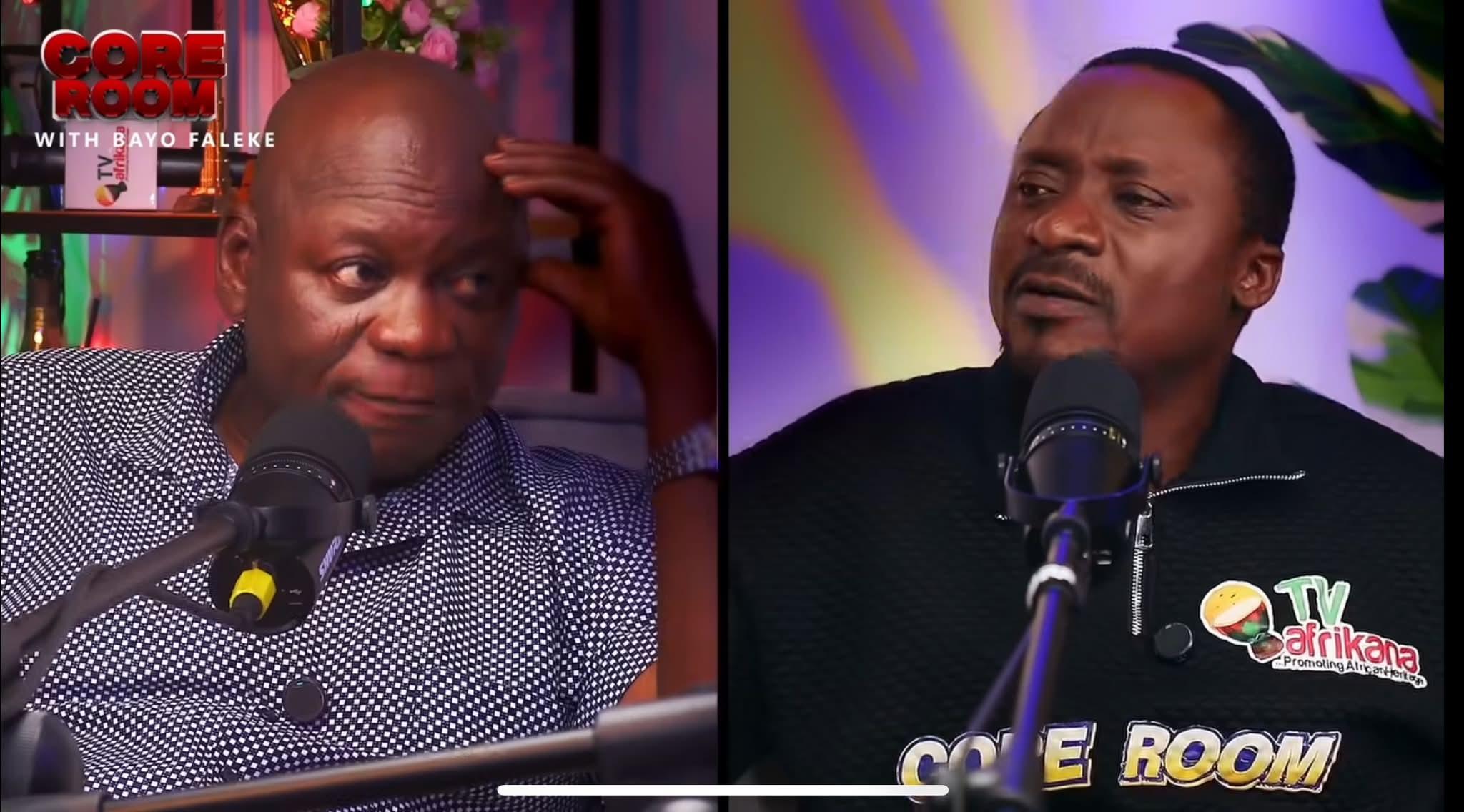
This is a continuation of my fact-check series on claims made by Mr. Sola Abegunde, a self-described public analyst and critic of the Oyo State Government, during his appearance on the CORE ROOM podcast hosted by Fresh FM journalist Bayo Faleke.
Let us set more of the record straight.
BUS TERMINALS: THE PRICE AND THE ROLE OF LOCAL GOVERNMENTS
Mr. Abegunde said bus terminals are the responsibility of local governments and that each of the four terminals built by the Makinde administration cost at least ₦8 billion. Using his own figure as the minimum, four terminals would cost ₦32 billion, and he suggested the real figure was higher still.
That claim does not match the public record. The Makinde administration published the contract sum for the four terminals at ₦17 billion in 2020, roughly $35 million at the time. Where, then, did the ₦8 billion per terminal figure come from? If a publicly available price can be misstated this easily, it raises a fair question about the reliability of the rest of the criticism.
There is also a useful comparison. Lagos State, often held up by APC members as the model for good governance in the Southwest, spent about ₦22.5 billion (roughly $70 million) on two bus terminals at Oshodi in 2016. The projects drew considerable fanfare. According to TheCable NG, then-President Muhammadu Buhari (rtd), alongside then-Lagos Governor Akinwumi Ambode, commissioned the Oshodi terminal in 2018 while it was still incomplete.
Consider the numbers again. Oyo State delivered four completed terminals for about $35 million, while Lagos spent about $70 million on two, four years earlier. Yet APC members in Oyo State, Mr. Abegunde included, regularly cite Lagos as the standard for good governance. I leave readers to judge the consistency of that position.
On whether bus terminals are a local government function, Mr. Abegunde is right that the constitution assigns certain duties to local governments. However, nothing in it stops a state government from building and maintaining transport infrastructure, terminals included.
Today, the terminals at Iwo Road (two), Challenge, and Ojoo have brought order to vehicle movement and eased traffic along those corridors, a real relief for commuters. Is there any offense in a state government intervening to deliver that kind of relief?
It is also worth asking where this insistence on boundaries between LGAs and the state was when Lagos spent $70 million on two terminals that needed a sitting President to commission them. Those terminals remain one of the achievements the APC points to when showcasing Lagos's development. Given that inconsistency, I leave the sincerity of the argument for readers to judge.
INCREASED ALLOCATION AND OYO STATE'S WAGE BILL
Since the Buhari years, it has become convenient for many APC members to deflect questions about federal responsibilities and turn instead to governors, pointing to the allocations states receive. That was not the posture when Goodluck Jonathan was President.
Governors also played a role in how past savings were handled. Former Finance Minister and Coordinating Minister of the Economy Dr. Ngozi Okonjo-Iweala, now Director-General of the World Trade Organization, proposed to the National Economic Council that Nigeria create a Sovereign Wealth Fund, and more than $20 billion in Excess Crude Account savings was later spent down. By her own account, only Peter Obi and Ibrahim Dankwambo supported the proposal. Leading voices against it came from governors who were then aligned with the APC. In my view, this is part of a pattern in which politics is placed ahead of national prosperity, much as it was with subsidy removal.
Inflation management is also the responsibility of the Federal Government and the Central Bank of Nigeria. That is the context for Governor Makinde's description of the Tinubu administration's approach as "voodoo economics." Monthly allocations, which are not handouts but a pool drawn from oil sales, VAT collected from states (Oyo is the third-highest VAT contributor nationally), and other resource receipts, may be nominally higher today. But they buy far less than the smaller allocations of the pre-2023 period, because inflation has pushed up the cost of everything from food to fuel to building materials.
Mr. Abegunde claimed Oyo State receives ₦68 billion monthly, made up of ₦34 billion in state allocation and ₦34 billion in LGA allocations, and that the state carries a wage bill of only ₦10 billion monthly, even with the wage award given to workers and retirees to ease transport costs.
Here are the figures as I have them.
FAAC allocation: Oyo State received ₦32.2 billion in June, the 7th highest in the federation.
VAT share: VAT accounted for 62.66% of that allocation, the second-highest share after Lagos at 84%.
LGA allocations: Oyo State received ₦132.96 billion between January and June 2026, the fourth largest.
Deductions: ₦16.49 billion was deducted from Oyo State's FAAC between January and June 2026, the 8th largest deduction in the federation.
Workforce: The state has over 130,000 active civil servants, the third largest workforce in the country after Lagos and Ekiti.
Wage bill: According to the Governor, the monthly wage bill is now ₦18 billion, up from ₦4.5 billion in 2019. This excludes the 13th-month bonus and the wage award.
Where, then, did the ₦34 billion monthly LGA figure and the ₦10 billion wage bill come from? Mr. Abegunde should show the source of his data.
The same scrutiny deserves to be applied elsewhere. Lagos received ₦77 billion in FAAC in June and ₦311 billion in LGA allocations in the first half of the year. Delta received ₦87 billion in FAAC in June, supported by substantial internally generated revenue. Have these states been held to the standard of scrutiny applied to Governor Makinde on road construction, school projects, and other infrastructure? Not to the same degree. This is despite the fact that Oyo State has a larger land mass than both states combined.
Governor Makinde has taken on more than 800km of road projects, with about 500km completed. That is the longest road completion by distance of any civilian governor in the country. The reason for the intensity of the criticism is not hard to see. Makinde is the most visible opposition voice among serving governors, and he contested the presidency against Bola Tinubu, whom many APC loyalists treat as beyond question.
Many of the things Oyo State is criticized for are being done on a larger scale in states with bigger resources and smaller deficits, but the criticism seems to be selectively directed.
Beyond road projects and workers' welfare, this administration has maintained constant payment of subventions to state-owned institutions, advanced the airport project, cleared over ₦134 billion in inherited gratuity backlogs and current obligations, and delivered school projects, all with far less revenue and debt than states like Lagos, Delta, and Rivers. Yet the steady stream of criticism, even where baseless, has been aimed at Oyo State rather than APC-controlled states. It is worth asking why.
It also recalls the treatment of President Goodluck Jonathan, whose policies were fiercely opposed in the media by the APC (then ACN and CPC). Look at what has happened in the 11 years since, with far less comparable scrutiny. Do we want the same to befall Nigeria again?
FINAL WORD
I write this as a citizen who has watched the state go through several phases of development over the past eight years. I have tried to point out the pattern of unfounded attacks and inconsistency from APC voices who offer no better alternative.
These are the checks that I believe Mr. Bayo Faleke should have carried out himself as a journalist on his own podcast. Failing to do so is a disservice to the people of the state he says he wants to see progress.
The ball is in your court. Follow the insinuations, or face the facts for what they are.

Leave a comment
Your email address will not be published. Required fields are marked *