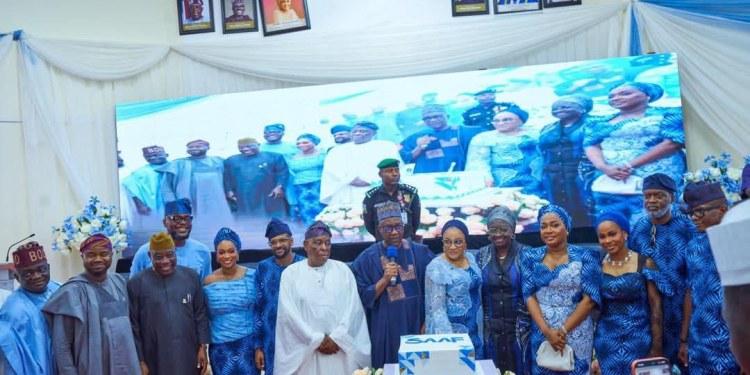
The ongoing national debate concerning the trajectory of Nigeria’s economic reforms became the focal point of the 8th Annual Senator Abiola Ajimobi Roundtable, where the Federal Government offered a vigorous defense of its fiscal policies amidst rising public anxiety. President Bola Ahmed Tinubu, speaking through his representative, the Executive Chairman of the Federal Inland Revenue Service (FIRS), Dr. Zacch Adedeji, utilized the platform to articulate a comprehensive justification for the administration's upcoming tax regime. The President’s message was strategically crafted to dismantle the prevailing narrative that new tax measures would exacerbate the suffering of the masses, instead positing them as necessary tools for economic redistribution and stabilization. He emphatically stated that the reforms scheduled for implementation in the coming fiscal year are not designed to impose additional burdens on the impoverished but are carefully structured to shield the most vulnerable demographics from the harsh winds of inflation. This assurance was delivered against the backdrop of the University of Ibadan, a setting that lent an air of intellectual rigor to the President’s policy pronouncements, reinforcing the administration’s claim that its economic strategies are the product of deep deliberation rather than impulsive reaction to revenue shortfalls.
Central to the President’s address was the specific detailing of exemptions that would characterize the new tax framework, a move intended to provide immediate psychological and financial relief to the citizenry. The President categorically declared that essential commodities which form the bedrock of daily survival for the average Nigerian—specifically food items, pharmaceutical products, and educational resources—would be completely exempted from the new tax levies. This policy decision highlights a deliberate attempt by the federal government to lower the cost of living and ensure that the pursuit of macroeconomic stability does not come at the expense of basic human needs. Furthermore, the agricultural and transportation sectors, which are critical drivers of the real economy and food security, were also listed among the beneficiaries of these tax waivers. By isolating these key sectors from fiscal aggression, the administration aims to stimulate domestic production and facilitate the seamless movement of goods across the country, thereby addressing the supply-side constraints that have historically fueled inflation in Nigeria. The President’s rhetoric suggested a shift towards a more progressive taxation model where the wealthy and corporate entities bear a fairer share of the national burden, allowing the working class to breathe more easily.
Transitioning from fiscal policy to the broader economic outlook, the President’s speech offered a candid assessment of the nation’s financial health, likening the current economic reforms to a necessary surgical procedure required to save a dying patient. He acknowledged that the removal of fuel subsidies and the unification of exchange rates had inflicted temporary hardship on the populace, but he argued passionately that these measures were unavoidable to avert a total collapse of the Nigerian economy. The narrative presented was one of short-term pain for long-term gain, with the President citing emerging indicators of recovery such as increased foreign direct investment and the gradual stabilization of the financial markets as evidence that the "surgery" was successful. He urged Nigerians to maintain their patience and confidence in the Renewed Hope Agenda, promising that the difficult decisions taken in the early days of his administration were beginning to yield the fruits of prosperity. This segment of the address was clearly aimed at managing public expectations and buying more time for the administration’s policies to mature, attempting to convert the current wave of economic discontent into a reservoir of hopeful resilience.
Beyond the technicalities of economics, the event served as a solemn commemoration of the political legacy of the late Senator Abiola Ajimobi, a figure whose governance style continues to cast a long shadow over Oyo State politics. President Tinubu paid a glowing and emotional tribute to the late governor, describing him not merely as a political ally but as a transformative leader who redefined the standards of governance in the state. The President recalled Ajimobi’s historic feat of breaking the "second-term jinx," a political superstition that had held the state captive for decades, as a testament to his administrative competence and acceptance by the people. He praised Ajimobi’s intellectual approach to leadership, noting how he successfully dismantled the "structures of violence" and brigandage that had once made Ibadan a theatre of political war. This retrospective analysis served to remind the audience of the stark contrast between the chaotic politics of the past and the era of modernization and urban renewal ushered in by the Ajimobi administration. The President’s words elevated Ajimobi from a mere partisan figure to a statesman whose blueprint for development remains a reference point for contemporary leaders in the South West region.
The President then pivoted to a direct and politically charged message addressed to the members of the All Progressives Congress (APC) in Oyo State, effectively sounding the battle cry for the 2027 general elections. He declared that the most profound way to honor the memory of Senator Ajimobi would be for the party faithful to set aside their internal squabbles and forge a united front capable of reclaiming the Agodi Government House. This directive was a clear acknowledgement of the fissures that have weakened the party in the state since the loss of power, and a strategic instruction from the national leader to prioritize collective victory over personal ambition. Tinubu charged the progressive family to emulate Ajimobi’s courage and political sagacity, warning that fragmentation would only prolong their time in the opposition wilderness. The call for unity was framed not just as a political strategy, but as a moral obligation to preserve the progressive legacy that Ajimobi had painstakingly built during his eight-year tenure, placing the burden of history squarely on the shoulders of the current party leadership in the state.
In a display of political maturity that defied partisan lines, the event was hosted by the incumbent Governor of Oyo State, Engr. Seyi Makinde, whose presence underscored the stature of the late Ajimobi as a leader of all Oyo people, regardless of party affiliation. Governor Makinde delivered a poignant critique of the Nigerian electoral system, identifying the twin evils of voter apathy and the widening trust deficit as the most potent threats to the survival of the nation’s democracy. He argued persuasively that the credibility of an election is not determined solely on voting day but is deeply rooted in the transparency of the processes leading up to it, particularly the internal democracy of political parties. Makinde warned that when political parties manipulate their primaries and impose unpopular candidates, they inadvertently disenfranchise the electorate long before the first ballot is cast. His analysis suggested that the solution to Nigeria’s electoral woes lies not just in technical reforms of the electoral umpire, but in a fundamental cultural shift within the political class to respect the will of the people at every stage of the democratic process.
The roundtable discussions were further enriched by intellectual interventions from a diverse panel of scholars and political experts who dissected the theme, "Pathways to Electoral Credibility: Performing Political Parties, Re-Engineering Citizens, and Restoring Trust in Nigerian Democracy." These experts engaged in a rigorous examination of the structural weaknesses that plague Nigeria’s democratic institutions, arguing that the citizenry has been reduced to passive observers rather than active stakeholders in the governance enterprise. The consensus that emerged from these deliberations was that restoring trust in the system requires a dual approach: political parties must evolve from vehicles of state capture into institutions of service, while the electorate must be sufficiently enlightened to resist the transactional politics of vote-buying. The speakers emphasized that legal reforms, no matter how robust, would remain ineffective without a "re-engineering" of the citizen’s mindset—a conscious effort to build a populace that demands accountability and refuses to be complicit in its own subjugation. This intellectual dimension of the event highlighted the critical role of civil society and academia in charting a path out of the nation’s political quagmire.
Bringing the event to a close, Dr. Florence Ajimobi, the President of the Senator Abiola Ajimobi Foundation and widow of the late governor, expressed her profound gratitude to the dignitaries for their continued solidarity with the Ajimobi family. She highlighted the unyielding loyalty of President Tinubu, noting that his consistent support for the Foundation was a reflection of the deep personal and political bond he shared with her late husband. Her remarks drew attention to the Foundation’s commitment to sustaining the intellectual legacy of the late Senator, ensuring that the annual roundtable remains a crucible for ideas that can propel the nation forward. The gathering, attended by high-profile figures such as the Speaker of the House of Representatives, Tajudeen Abbas, and the Governor of Imo State, Hope Uzodimma, served as a powerful affirmation of Ajimobi’s enduring influence. As the stakeholders dispersed, the event left a resonant message: that the convergence of sound economic policy and credible electoral processes is the only viable pathway for Nigeria to fulfill its immense potential and honor the memory of its past heroes.

Leave a comment
Your email address will not be published. Required fields are marked *