
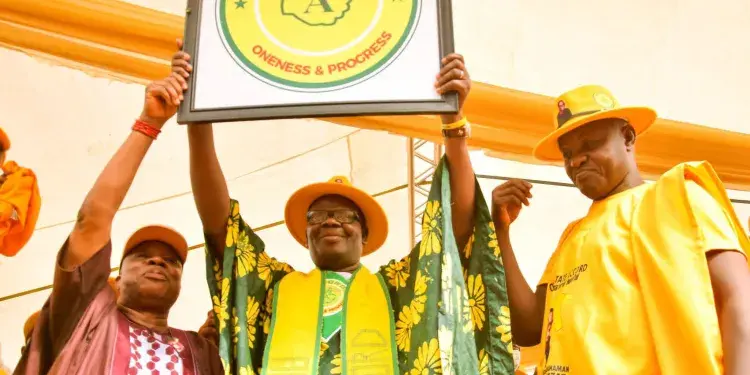
In a political climate often dominated by career politicians and established dynasties, the formal entry of Oriyomi Hamzat into the 2027 Oyo State gubernatorial race marks a significant shift in the state's democratic engagement. The renowned broadcaster, whose voice has long served as a conduit for public grievance and social justice, has traded the comfort of his radio studio for the volatile arena of partisan politics. This transition, described by analyst Waris Hamzat as a move "from microphone to megaphone," represents a critical test of whether populist media influence can be successfully converted into electoral authority.
Hamzat’s declaration, staged at the historic Obafemi Awolowo Stadium in Ibadan, was not merely a campaign launch but a demonstration of the "emotional proximity" he shares with the electorate. For years, through platforms like his popular radio program Kokoro Alate, he has functioned as a de facto ombudsman, mediating disputes and challenging authority on behalf of the downtrodden. This history of advocacy has cultivated a reservoir of trust that traditional politicians often struggle to build. His campaign slogan, "Òyó N' Pe Ọ́" (Oyo is Calling You), cleverly frames his ambition not as a personal quest for power, but as a reluctant obedience to a public mandate—a classic populist strategy that positions him as the people's answer to elite failure.
However, the analysis suggests that the path from activist to administrator is fraught with challenges. While his ability to mobilize "outrage and empathy" is unquestioned, governance requires a different set of skills: policy formulation, institutional discipline, and technocratic rigour. Critics argue that his populist appeal, though potent, may lack the structural depth necessary to navigate the complex bureaucracy of state governance. The piece draws parallels with other anti-establishment figures who rode waves of public disillusionment, noting that while emotional connection can win elections, it does not guarantee successful governance.
Furthermore, Hamzat’s entry has already begun to disrupt the existing political equilibrium. The recent dismissal of a local council administrator for merely attending his declaration signals that the ruling class views him as a genuine threat rather than a fringe candidate. This reaction underscores the potency of his "Third Force" movement, which seeks to bypass established party machinery by appealing directly to the masses. By running on the platform of the Accord Party, he is attempting to resurrect a political alternative that has historically played the role of kingmaker in Oyo State politics.
The narrative of Hamzat’s rise is also complicated by recent controversies, including legal challenges following a tragic stampede at a charity event he organized. These incidents have tested his public image, forcing him to navigate the fine line between being a "protector" of the people and a liability. Yet, his supporters view these tribulations as scars of his struggle against the system, further cementing his status as a martyr for the common man.
Ultimately, Oriyomi Hamzat’s bold leap into politics forces a re-evaluation of how power is acquired in modern Nigeria. It suggests a growing fatigue with traditional political gatekeepers and a hunger for leaders who are perceived as accessible and authentically connected to the grassroots. Whether this "megaphone" politics will translate into a seat at the Agodi Government House remains to be seen, but it has undeniably altered the texture of the conversation leading up to 2027. The broadcaster has successfully turned the volume up; the question now is whether the electorate likes the sound of his new song.

Leave a comment
Your email address will not be published. Required fields are marked *

