
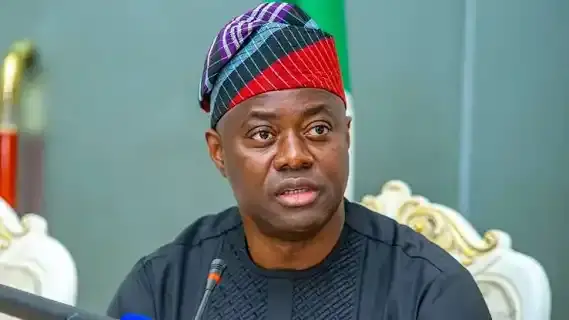
The political narrative in Oyo State has undergone a seismic shift in recent days, moving from a debate about the existence of federal funds to a far more damaging interrogation of administrative negligence. The controversy, ignited by allegations from former Ekiti State Governor Ayodele Fayose, has forced the Oyo State Government into a defensive posture that has inadvertently exposed a significant lapse in governance. At the heart of the matter is the admission by the state’s handlers that a staggering thirty billion naira—part of a federal intervention for the January 2024 Bodija explosion—has been sitting idle in a government account for nearly two years. This revelation has transformed what was initially a political mudslinging contest into a serious indictment of Governor Seyi Makinde’s crisis management capabilities and his empathy for the victims of the tragedy.
The initial defense mounted by the state government sought to clarify that the total sum received was thirty billion naira, not the fifty billion alleged by critics. They further claimed that the remaining twenty billion was withheld by the Federal Government due to the Governor’s refusal to accede to political conditions involving the restructuring of the All Progressives Congress (APC) in the state. While this narrative was intended to paint the Governor as a principled victim of high-wire politics, it has largely backfired. Public scrutiny has swiftly pivoted to the question of why the available thirty billion was not deployed. The logic that the state could not spend the "partial" release while waiting for the "balance" rings hollow to many observers, particularly given the dire straits of those who lost their homes and livelihoods in the blast.
From a governance perspective, the decision to hoard such a colossal sum while victims languished in temporary shelters or struggled to rebuild is difficult to justify. Emergency intervention funds are, by definition, meant for immediate relief and rehabilitation. To treat thirty billion naira—a sum larger than the annual budgets of some ministries—as a "partial" amount that must await completion before utilization is a bureaucratic absurdity that borders on callousness. The analysis suggests that the administration prioritized political leverage over humanitarian aid, perhaps hoping to use the funds as a bargaining chip or a future war chest, rather than treating them as a sacred trust for the distressed citizenry.
The political implications of this "silence" are profound. Governor Makinde has cultivated a brand as a "moral alternative" within the opposition Peoples Democratic Party (PDP), often positioning himself against the transactional politics associated with figures like the FCT Minister, Nyesom Wike. However, this scandal threatens to erode that carefully curated image. By admitting that federal funds were received but not acknowledged publicly until a whistleblower forced the issue, the Governor appears to be engaging in the very opacity he often criticizes in others. It hands his political rivals, including the presidency, a potent narrative: that the opposition governor is sabotaging federal efforts to aid his own people to score cheap political points.
Furthermore, the "unspent" defense raises uncomfortable questions about fiscal responsibility. In an economy characterized by double-digit inflation, the purchasing power of thirty billion naira in 2026 is significantly lower than it was in early 2024. By leaving the funds dormant, the state government has effectively presided over the devaluation of the relief package. Critics are now asking whether the funds were truly idle or if they were placed in interest-yielding accounts, and if so, where the accrued interest has gone. These are forensic questions that the administration will find difficult to answer without a comprehensive and independent audit, a demand that is growing louder by the day.
The controversy also exposes the fragility of the Governor's communication strategy. The conflicting statements—first a denial, then a clarification, and finally a justification for non-expenditure—suggest a chaotic response mechanism within the Agodi Government House. It appears the administration was caught off guard by the precision of Fayose’s leak and scrambled to construct a narrative that could accommodate the undeniable facts. This reactive approach has done little to restore public confidence, instead fostering a perception of a government that is hiding more than it is revealing.
For the victims of the Bodija explosion, this bureaucratic ping-pong is a cruel reopening of old wounds. Many have reportedly received only token support from the state, believing that resources were scarce. To learn now that billions were available but withheld due to administrative rigidity or political gamesmanship is a betrayal of the social contract. The "inducement" excuse regarding the withheld twenty billion naira, even if true, does not absolve the government of its duty to utilize the thirty billion naira that was in its possession. A responsible government would have deployed the available resources to make a tangible impact while fighting for the balance, rather than freezing the entire process.
Ultimately, Governor Makinde finds himself at a critical juncture. To salvage his reputation, he must move beyond defensive press statements and provide a transparent, line-by-line account of the fund’s status. The "odds" mentioned in political circles are no longer just about his 2027 ambitions or his battle for the soul of the PDP; they are about his legacy as a leader who stood by his people in their darkest hour. If this narrative of negligence is allowed to stick, it could prove to be the defining scandal of his second term, overshadowing his infrastructural achievements and leaving a permanent stain on his record of service.

Leave a comment
Your email address will not be published. Required fields are marked *

