
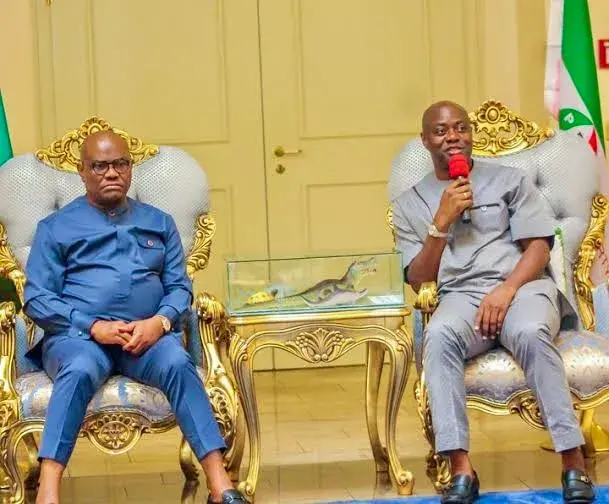
Oyo State Governor, Engr. Seyi Makinde, has drawn a definitive battle line regarding the 2027 general elections, publicly declaring that he will not lend his support to the anticipated re-election bid of President Bola Ahmed Tinubu. In a candid media chat held in Ibadan on Monday, the Governor positioned his refusal not merely as a partisan maneuver, but as a critical stand for the survival of Nigeria's multiparty democracy. His comments signal a significant departure from the camaraderie that characterized his relationship with the ruling center during the 2023 transition, suggesting that the political alliances of the past have fractured under the weight of conflicting visions for the nation’s democratic future. Makinde argued that allowing the opposition to be subsumed by the ruling party would effectively turn Nigeria into a one-party state, a trajectory he is vowed to resist vigorously to ensure that the electorate retains valid alternatives at the polls.
The Governor provided a rare glimpse into the high-level power play currently fracturing the Peoples Democratic Party (PDP), revealing the specifics of a tense meeting involving himself, President Tinubu, the Chief of Staff Femi Gbajabiamila, and the Minister of the Federal Capital Territory, Nyesom Wike. It was during this strategic engagement that the ideological rift between Makinde and his former ally became undeniable. According to Makinde, Wike voluntarily offered to "hold the PDP" for President Tinubu ahead of the 2027 election cycle. This unsolicited pledge to effectively deliver the main opposition structure to the ruling party reportedly left Makinde in a state of shock. He emphasized that the President had not requested such a surrender; rather, it was an independent initiative by the FCT Minister to consolidate political control, a move that Makinde immediately recognized as an existential threat to the PDP’s sovereignty.
In his narrative of the encounter, Makinde recounted his immediate and forceful rejection of the proposal. He reportedly told Wike to his face that he would never be a party to such a scheme, effectively dissolving the political bond that had previously united them under the "G5" banner. The Governor clarified that while he respects Wike’s right to align with President Tinubu and serve in his cabinet, he demands the reciprocal right to chart a different course. He argued that the integrity of the political system depends on the existence of a robust opposition that is not beholden to the incumbent administration. By offering to "hold" the party for the President, Wike was, in Makinde's view, attempting to neutralize the PDP from within, a strategy that Makinde is now actively mobilizing against to preserve the sanctity of the party's constitution and its role as a check on executive power.
To buttress his stance and dismiss any notion that his political choices are driven by financial desperation or a need for federal patronage, Governor Makinde deployed a stinging comparison of his early career trajectory versus that of the FCT Minister. He reminded the audience that his entry into politics was preceded by a highly successful career in the private sector, specifically in the oil and gas industry. "At the age of 29, I secured my first major contract with Mobil worth $1 million," Makinde stated, adding the sharp contextual qualifier that at that same point in history, "Nyesom Wike had probably just left law school." This comparison was not merely biographical; it was a calculated assertion of autonomy, intended to demonstrate that unlike career politicians who rely on the state for sustenance, his financial independence allows him to speak truth to power without fear of economic retribution.
The reference to the "$1 million contract" serves to highlight the fundamental difference in the operational philosophies of the two leaders. Makinde portrayed himself as a technocrat who entered the political arena to serve, armed with the resources and mindset of a self-made entrepreneur. In contrast, the remark subtly casts his opponents as individuals whose political survival is tethered to their proximity to the treasury or federal might. By emphasizing his early success in the competitive corporate world, Makinde is signaling to his base and the wider electorate that he cannot be bought or intimidated. This narrative of independence is likely to become a central theme of his political messaging as the race for 2027 gathers momentum, positioning him as the uncompromised face of the opposition in the South West.
The Governor's revelations have laid bare the deep-seated divisions plaguing the PDP, effectively categorizing the party's stakeholders into two distinct camps: those aligned with the Wike-led faction that seeks cooperation with the APC, and the "autonomy faction" led by Makinde and other like-minded governors. This schism complicates the party's rebuilding efforts, as it suggests that the battle for 2027 will first be fought internally before a single ballot is cast in the general election. Makinde’s insistence on "multiparty democracy" suggests that he views the current internal struggle as a fight for the soul of the PDP. If the party is "held" for the President as Wike allegedly proposed, it would cease to function as an opposition entity, creating a political monopoly that Makinde warns would be detrimental to the nation’s development.
Despite several attempts by mutual associates to mediate the conflict and salvage the relationship between the two political heavyweights, Makinde indicated that the situation remains intractable due to the fundamental divergence in their objectives. He noted that he has moved past the point of negotiation on this specific issue, as it touches on the core values of political association. The Governor expressed a readiness to face whatever consequences arise from his defiance, reinforcing his commitment to the PDP’s original mandate. He urged other party members to wake up to the reality of the plot to hijack the party structure, warning that silence or neutrality at this juncture would be tantamount to complicity in the death of the opposition.
As the political atmosphere heats up, Governor Makinde’s bold declarations are expected to trigger a realignment of forces within the South West and the PDP nationally. His refusal to back the President, coupled with his open challenge to the FCT Minister, places him in the crosshairs of the federal might. However, his confidence, rooted in his "law school vs. $1 million" narrative, suggests he is prepared for a protracted attrition war. The coming months will reveal whether Makinde can successfully rally the fragmented opposition into a cohesive force or if the machinery he is fighting against will overwhelm his resistance. For now, the line is drawn: Makinde stands alone if he must, banking on his history of independence to navigate the treacherous waters ahead.

Leave a comment
Your email address will not be published. Required fields are marked *

