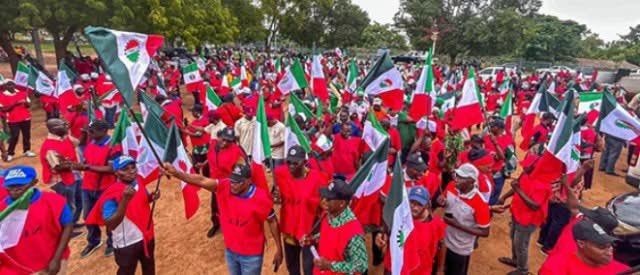
Their demand follows recent wage increases by several state governments who raised workers’ salaries above the ₦70,000 benchmark to cushion the impact of economic realities.
President Bola Tinubu had signed the new National Minimum Wage Bill into law in July 2024, raising the wage from ₦30,000 to ₦70,000 for workers across all tiers of government and the private sector. However, inflation has eroded its value, with states like Imo, Lagos, Rivers, and others already implementing higher pay structures.
On August 27, 2025, Imo State increased its minimum wage to ₦104,000, following an agreement between Governor Hope Uzodinma and organised labour. Lagos had earlier pegged its minimum wage at ₦85,000 in October 2024, with a pledge to raise it further to ₦100,000 in 2025, while Rivers, Bayelsa, Niger, Enugu, Akwa Ibom, and others also announced upward reviews ranging from ₦73,000 to ₦85,000.
Speaking to the News Agency of Nigeria (NAN), NLC’s Acting General Secretary, Mr. Benson Upah, stressed that ₦70,000 is inadequate under present economic conditions. He warned that without urgent government intervention, many workers may be pushed into deeper hardship.
“The truth is ₦70,000 is not sustainable. Workers are under immense pressure, and unless government responds quickly, the crisis of survival will worsen,” Upah said, adding that while labour favours dialogue, industrial action may be considered if negotiations stall.
Similarly, the President of the Association of Senior Civil Servants of Nigeria (ASCSN), Mr. Shehu Mohammed, praised states that had reviewed wages upward, describing them as role models for the Federal Government. He recalled that labour initially demanded ₦250,000 as a realistic benchmark for a living wage.
“Even if you pay electricity bills from ₦70,000, what is left cannot sustain a family for 10 days,” Mohammed noted, urging government to back wage reviews with policies that reduce the cost of living through affordable housing, healthcare, and subsidised transport.
Several federal civil servants also shared their frustrations. Mrs. Kemi George said transport, food, rent, and school fees were almost impossible to cover with her salary. Mr. Obi Chimaobi described the situation as “unbearable,” stressing that workers were sinking into debt before month’s end.
Another worker, Mrs. Bola Akingbade, argued that “a well-paid workforce is a motivated workforce,” stressing that higher wages would boost productivity and reduce corruption.
Mr. Jeremiah Okon also pointed out that if states with smaller revenues could adjust wages upward, the federal government had no excuse. He suggested ₦150,000 as a fairer national minimum wage, describing it as not just a worker’s demand but a tool for stimulating economic growth.
Leave a comment
Your email address will not be published. Required fields are marked *