
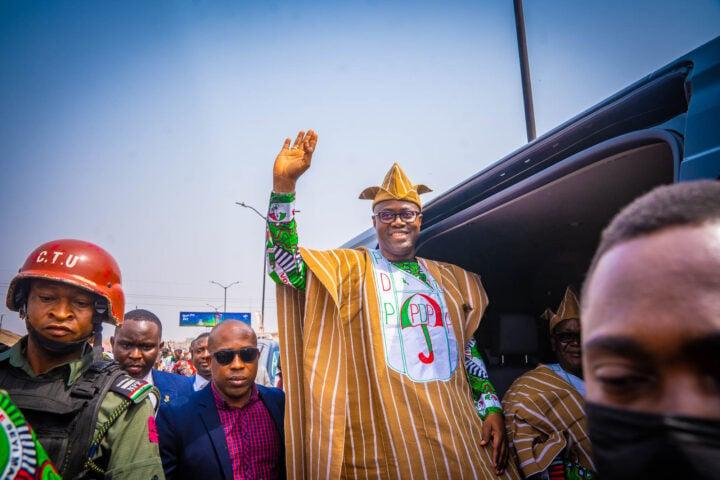
In the treacherous arena of Nigerian politics, where self-interest inexorably shapes every stratagem and decision, the escalating supremacy battle between Oyo State Governor Seyi Makinde and the Minister of the Federal Capital Territory, Nyesom Wike, lays bare the raw calculus of ambition. This confrontation over the control of the Peoples Democratic Party (PDP) is no mere factional squabble; it is a high-stakes struggle fueled by clashing egos and divergent visions for the future of a party that once prided itself as the largest political entity in Africa. While Makinde clings with unyielding tenacity to the remnants of the party, determined to salvage its viability, Wike is portrayed as projecting an insidious allegiance—one that seems fixated on the party's annihilation to serve personal vendettas.
The governor’s current posture evokes a striking historical parallel with President Bola Tinubu’s days as Governor of Lagos State. Just as Tinubu stood indomitable against the formidable federal machinery of former President Olusegun Obasanjo in 2004, refusing to capitulate despite withheld allocations, Makinde is attempting to embody a similar strategic defiance. Facing what critics describe as Wike’s "wrecking-ball tactics"—characterized by proxy godfathers and defection inducements—Makinde has opted for resilience over rupture. Where his adversary revels in scorched-earth politics, the Oyo Governor is investing in reconstruction, rallying the PDP faithful against centrifugal forces. However, a crucial difference exists between the Tinubu of the Lagos era and the Makinde of today: a festering integrity question at home that threatens to undercut the moral high ground he claims in the national party war.
The Ibadan explosion of January 2024 and the subsequent controversy over an alleged fifty billion naira relief fund have dragged the governor's credibility into the dock. The accusations, initially leveled by former Ekiti State Governor Ayodele Fayose, claimed that Makinde secretly collected the colossal sum from the presidency. The governor’s initial response was a denial. However, under sustained scrutiny, the narrative shifted significantly. The administration admitted that Abuja had indeed released thirty billion naira, insisting that the remaining twenty billion was withheld because the governor refused to politically realign with the ruling party. This explanation, rather than closing the chapter, has opened a Pandora's box of questions regarding transparency.
If the federal government allegedly dangled twenty billion naira as a carrot for partisan alignment, the logical expectation for a leader positioning himself as a moral alternative would be full transparency regarding the thirty billion acknowledged as received. Instead, the Oyo State Government has made the startling claim that it has yet to spend the funds. On paper, this may be presented as prudence or administrative caution. But on the streets of Ibadan, where victims still lament inadequate support and the slow pace of rebuilding, it resonates as a cruel joke. The disconnect is palpable: how does a government that repeatedly invokes the enormity of the disaster confess that billions remain idle, untouched, somewhere between rhetoric and reality?
Taken together, the shifting narrative—first a denial of fifty billion, then an admission of thirty billion, followed by the claim of non-expenditure—puts the Makinde administration in a tight corner. It is not merely a public relations problem; it is a full-blown credibility crisis. A leader who aspires to stand as the conscience of the PDP cannot afford "elastic truth." Once figures keep changing and explanations appear reactive rather than proactive, the claim to moral superiority over rivals starts to look like convenient self-righteous posturing. If the governor alleges that federal agents sought to blackmail him, he owes the public more than soundbites; he owes a forensic breakdown of what was requested, approved, received, and utilized.
This is where the Makinde versus Wike contrast becomes more complicated than the simple "builder versus destroyer" framing. Wike’s politics is openly transactional and brazen; he does not pretend to be a saint. Makinde, on the other hand, sells himself as the modern, methodical reformer determined to keep the PDP alive. That image rises or falls on integrity. One cannot rally a wounded party around a banner stained by unanswered questions over disaster funds. True political longevity demands not just cunning but conviction—and in a democracy, conviction is measured by consistency and accountability.
If Governor Makinde lets the Ibadan explosion funds scandal linger in obscurity, he risks forfeiting any claim to being the moral alternative in the opposition landscape. He is betting against the odds, positioning himself as the PDP's phoenix, yet a phoenix cannot rise on the wings of half-truths and contested narratives. In this political coliseum, the odds may still favor the steadfast navigator over the nihilistic destroyer, but only if the navigator’s compass is trusted. The governor’s real battle is now twin-fold: resisting the external attempts to wreck the party from within, and proving, through radical transparency and prompt action, that his own hands are clean enough to lead a rebuilding project.
Ultimately, if the administration fails the integrity test at home in Oyo—on an issue as sensitive as the Ibadan explosion and its attendant billions—the moral argument against detractors collapses under its own weight. When that happens, the thin line separating the supposed builder from the confessed destroyer vanishes, leaving the opposition with not a savior, but two different faces of the same political cynicism. The challenge for Makinde is to ensure that his legacy is not defined by the silence of unspent billions while his people wait for relief.

Leave a comment
Your email address will not be published. Required fields are marked *

