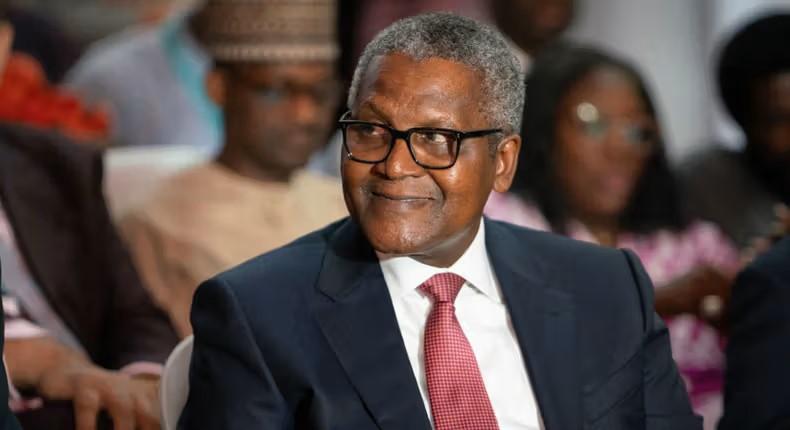
Aliko Dangote, President of Dangote Industries Limited, has pushed back against longstanding allegations that his companies dominate and stifle competition in critical sectors of Nigeria’s economy.
In a recent interview, Dangote defended his approach to business, emphasizing the importance of industrialisation across Africa and cautioning against reliance on foreign imports. "Africa must stop being a dumping ground," he asserted.
The Dangote Group has often been accused of leveraging its influence to suppress rivals, criticisms that have intensified following the $20 billion launch of the group’s oil refinery. Despite the backlash, Dangote maintains that his achievements stem from calculated investments and entrepreneurial foresight, not from undue advantages or protectionist policies.
A Thursday feature by Bloomberg noted that some of Dangote’s biggest ventures such as in sugar and cement are in industries where imports are limited or banned. The report referenced a 2007 cable by then-US Consul General Brian Browne, released by WikiLeaks, which quoted critics describing Dangote as exploiting political connections to sideline competition.
Browne wrote: “To detractors, he is a predator using connections in a corrupt political economy to tilt the playing field in his favour... It is no coincidence that many products on Nigeria’s import ban lists are items in which Dangote has major interests.”
While expressing respect for Browne, Dangote rejected the claim, insisting that the imports in question were not restricted when he entered those markets. He framed his actions as seizing business opportunities that others ignored.
“If being a first mover makes one a monopolist, then you’ll never build a manufacturing sector, let alone a functioning nation,” he said.
Dangote also shared the immense challenges of building the refinery, citing the lack of reliable public infrastructure. “From day one, we realized we’d have to provide nearly everything ourselves,” he said, reflecting on the experience. “Had I known the level of difficulty, I might not have started at all.”
According to the Bloomberg Billionaires Index, Dangote’s fortune has surged by around $1 billion in the past three months, reaching $28 billion, boosted by the refinery’s success which has made Nigeria a net exporter of petroleum products for the first time in 30 years.
He denied receiving preferential foreign exchange access or engaging in corruption. “We’ve earned our wealth legitimately. We’re not part of the corruption, we’re solving problems,” Dangote said.
Dangote Industries positions itself as a key driver of Nigeria’s industrialisation. Devakumar Edwin, the company’s Vice President overseeing the refinery, emphasized its transformative potential: “This refinery will reshape the business landscape. We're exporting refined products, not just raw materials.”
Dangote’s entrepreneurial journey began in the 1970s in Kano, with a $3,000 loan from his uncle. He initially traded agricultural commodities like cotton and cashew nuts, eventually expanding into transportation and cement imports—laying the foundation for what would become one of Africa’s most powerful conglomerates.
Leave a comment
Your email address will not be published. Required fields are marked *